Frequently Asked Questions
Are 'khakis' and 'chinos' the same thing?In the most simple terms possible:
- Khaki = a shade of light brown.
- Chino = a type of pants (named after the fabric known as 'chino cloth').
Though the original khaki shade is the most popular option, chinos come in many different colors, so calling them 'khakis' is not actually correct. Also, some brands call their chino pants 'khakis', but this is just branding and not representative of reality.
Are chinos suitable for formal occasions or just casual wear?Chinos may be versatile but they're _not_ a formal item. They are business casual at their most dressy point and they should not be worn in place of dress pants or suit pants - ever.
Can you wear chinos all year round?Though navy chinos can be a reliable substitute for dark-wash jeans, you should refrain from wearing them during the colder months or in cold climates.
Chino twill is a much lighter fabric and looks off when worn with heavier wool items. You're better off sticking with heavily weighted materials like denim and wool when the weather starts to cool down because they pair better with sweaters and heavier jackets.
Are chinos and khakis the same?Not exactly. "Khaki" originally refers to a color (a sandy light-brown), while "chino" refers to a type of pant made from cotton twill. All khaki-colored pants are not chinos, and not all chinos are khaki. Most modern brands use the words interchangeably, which adds to the confusion. See the "Chinos vs Khakis" section below for the full breakdown.
Can chinos be business casual?Yes. Chinos in navy, charcoal, stone, or olive — paired with a tucked Oxford shirt and leather shoes — are a core business casual outfit. Add a blazer for client meetings or interviews. Avoid chinos in bright colors or with cargo pockets for office wear. Stone and khaki chinos with loafers are also foundational to the old money fashion guide.
What color chinos should I buy first?Stone (light tan) is the most versatile starter chino — pairs with virtually every shirt color and shoe color. Navy is the second pick — works as a chino-version of dark jeans. Charcoal third for cooler-weather and office wear. Skip black, white, and brightly colored chinos until you own these three.
What Are Chinos?
Chinos are mid-weight cotton twill pants designed to sit between casual jeans and formal dress trousers. They're one of the most versatile pant categories in menswear and are a wardrobe essential for every man.
The Origin of Chinos
The word "chino" comes from Latin American Spanish, meaning "toasted" — a reference to the original pant's signature tan color. The fabric itself, called "chino cloth," is a tightly woven cotton twill originally manufactured in China for the British military in the 1800s. American soldiers picked them up during the Spanish-American War, and they entered civilian wardrobes after WWII.
What Defines Chino Pants
Three things make a pant a chino:
- Fabric: Mid-weight cotton twill (chino cloth). Smooth-faced, slight sheen, durable.
- Construction: Flat-front (no pleats), side-seam pockets (not front-loading like jeans), simple back welt pockets.
- Cut: Slim to straight leg, sits at the hip, hemmed clean (no cuff, no stacking).
Chinos vs. Cargo Pants vs. Khakis vs. Slacks
- Chinos = cotton twill, smooth, no extra pockets
- Cargo pants = chinos with extra utility pockets (not chinos in the proper sense)
- Khakis = a color name; "khakis" is often used as a synonym for tan-colored chinos
- Slacks / dress pants = wool or wool-blend, dressier, often with a center crease
If a pair of pants has cargo pockets, leg stitching, hammer loops, or pre-pressed creases — they're not classic chinos.
Chinos vs Khakis: Difference Explained
This is the most-asked chino question. Here's the clean answer:
| Term | What It Means |
|---|---|
| Chinos | A type of pant made from cotton twill. Refers to the fabric and construction, not the color. |
| Khakis | Originally a color (light tan/sandy brown). Today, also used loosely as a synonym for tan-colored chinos. |
The Common Sources of Confusion
- Brands use the terms interchangeably. Many retailers sell "khakis" that are technically chinos.
- All khaki-colored chinos are sometimes just called "khakis." This isn't wrong — it's just imprecise.
- Not all chinos are khaki-colored. Navy chinos, olive chinos, and stone chinos are still chinos.
The Quick Test
- If the pant is cotton twill with a flat front and side-seam pockets → it's a chino.
- If the pant is light tan in color → it's also khaki-colored.
- A navy chino is a chino but not a khaki. A tan chino is both.
For a deeper comparison, see our chinos vs khakis breakdown.
Chino Pants Mistakes Most Men Make
I see a boatload of guys making the following mistakes, so I want you to be aware of them:
- Do not wear or own black chino pants.
You'll look like a waiter or valet guy. Hey, take it up with the service industry, not me!
- Chinos should be worn with a quarter or no break at the hem (bottom of the pant leg).
They can even be worn at ankle length in some cases, but never, ever longer than a quarter break.
- Chino pants do not have extra pockets on the legs, hammer loops, stitching, etc.
Those aren't chinos, no matter what their name says.
- Don't wear pleated chinos.
They may look okay on a model and in pictures but in person, they just don't look right.
- Pressed creases on the legs are the devil's work.
Don't ever buy them like this or add them yourself.
- The same goes for pre-cuffed hems.
Don't wear them, please. You can roll the cuff later on but don't buy the ones that come pre-cuffed.
Anatomy of Chinos
Here are some of the key things to look out for when shopping for your next pair of chinos:
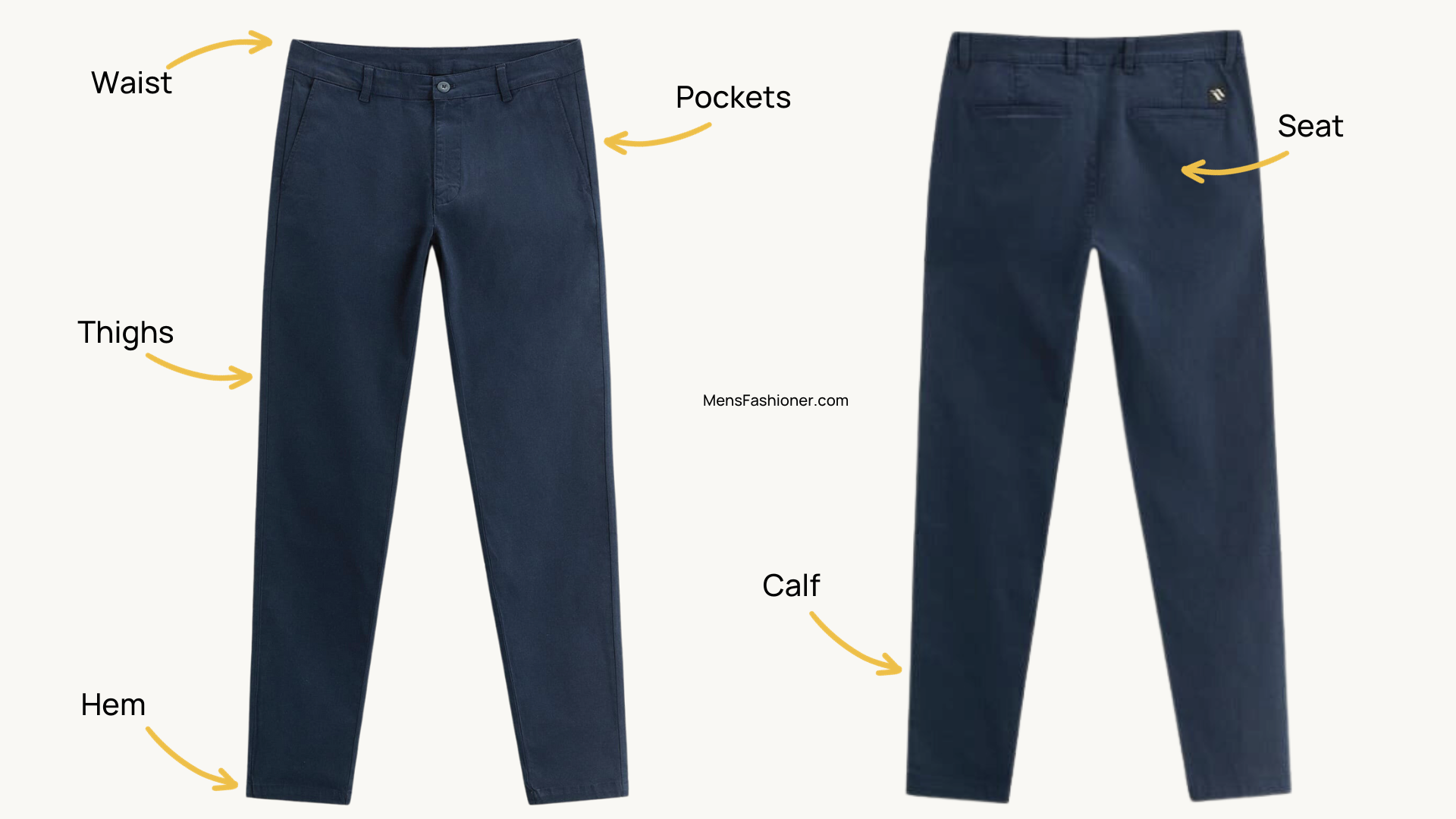
Waist {#waist}
For chinos, the waist will sit lower than suit pants but should hit exactly where the waist of your jeans should be – right in between the upper and the mid-hip-bone area.
Like your jeans and suit pants, they should fit your waist without the need for a belt.
Pockets {#pockets}
Chino pants will also usually have side-loading pockets, which are different than the traditional front or top-loading pockets traditionally found on jeans.
Seat {#seat}
The seat of your chinos should _lightly_ hug your butt without being either too tight or too baggy.
If it feels like you'll split your pants when you sit or bend down, the chinos are too tight. If it looks really saggy in the butt, you should probably try a different fit or brand. If that doesn't work, you may also be able to go down a size and see if that fixes the issue. And, if that doesn't work, you can get the upper thighs taken in by a tailor to compensate for the extra room in the seat.
Thighs {#thighs}
Just like with all your pants, the thighs of your chinos shouldn't fit too tight or too loose.
You should only be able to pinch 1-2 inches (2.5-5cm) on either side of your thigh. If you can pinch more than that, try a different style or brand or, if possible, go down a size. As a last resort, you can get a tailor to slim the legs to this size, but just like taking in the seat of your chinos, it'll probably cost more than buying a whole new pair of pants.
Calf {#calf}
You should only be able to pinch 1-2 inches (2.5-5cm) of fabric on either side of your calf and ankle.
Break {#break}
The "break" of the pant is the fold or fabric crease that forms at the front of your pant leg while you're standing, (just above where the hem meets your shoe).
The image below shows the different types of pants breaks:

Your chinos should be hemmed to have a quarter or no break, and should not have much bunching (also called 'stacking') of fabric around the ankle. This will throw off the way your proportions look.
Colors
You should own at least one pair of chinos in the colors outlined below. These will pair easily with all the other items in your wardrobe.
Sand {#sand}
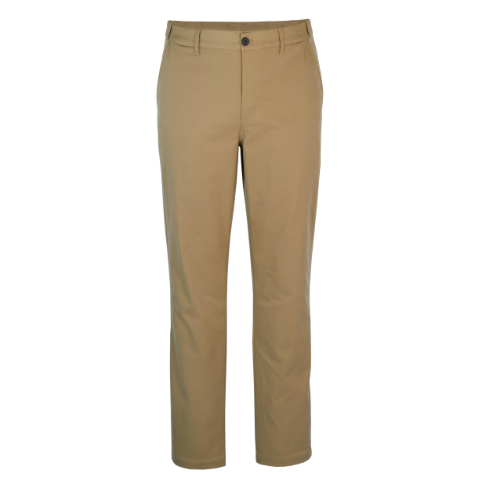
- I prefer this lighter brown/tan color to the darker, flatter khaki color.
- Some brands will call sand-colored pants 'khaki', so just go for lighter brown colors regardless of what the brand calls them.
Navy {#navy}
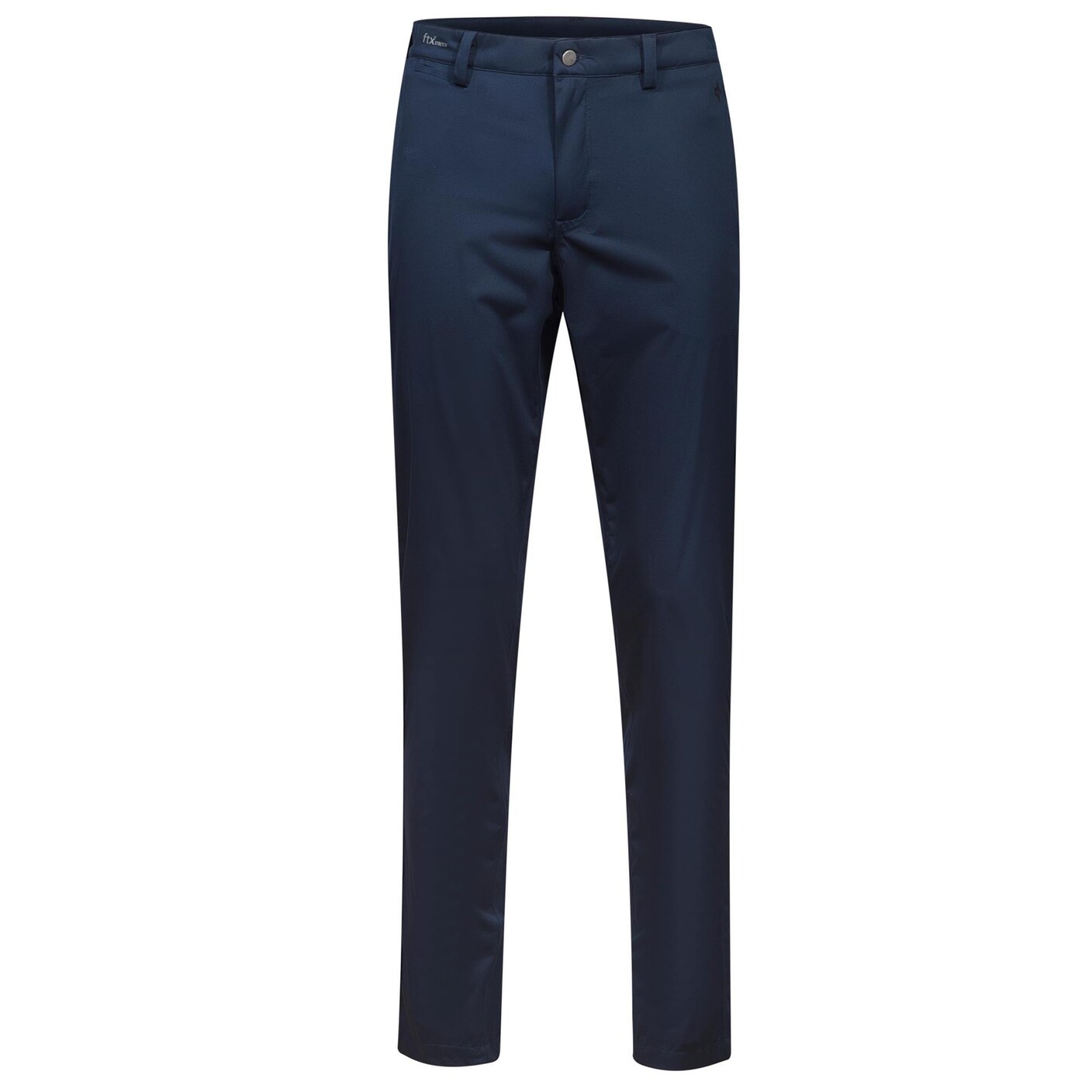
- Navy is a super versatile chino color that can be easily swapped into your dark-wash jean outfits.
- It works particularly well during the warmer months or in warmer climates.
- Whatever you do, just don't get such a dark navy that it looks black.
- That's a big no-no.
Olive {#olive}
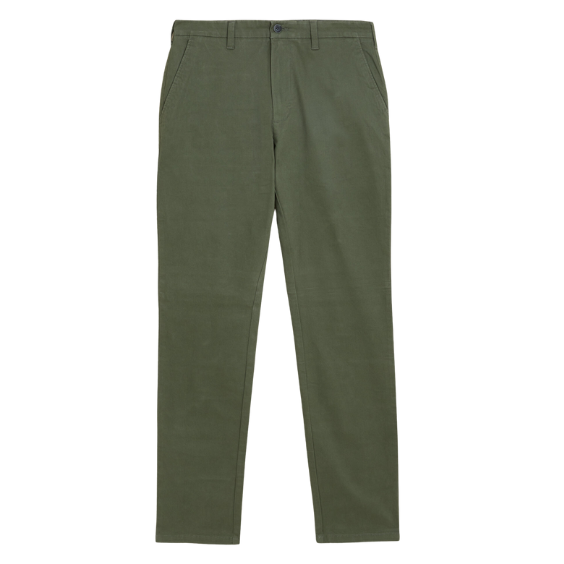
- This color is great to have in your wardrobe for when you want something darker than sand, but not as dark as navy blue.
- It looks particularly good during the fall months.
Fabrics
- Traditionally, chinos are crafted from chino cloth (from which they get their name).
- However, you can also find them made from more durable technical fabrics that allow for more stretch and greater protection from the elements.
- Be careful, though, because tech fabrics can have a shine or sheen to them that doesn't look right in real life.
- Skip the technical fabrics and go for regular chino cloth, maybe with some stretch in them unless you absolutely need the tech fabrics for a specific purpose.
- Classic chinos have a more matte finish which always looks both timeless and stylish.
How Chino Pants Should Fit
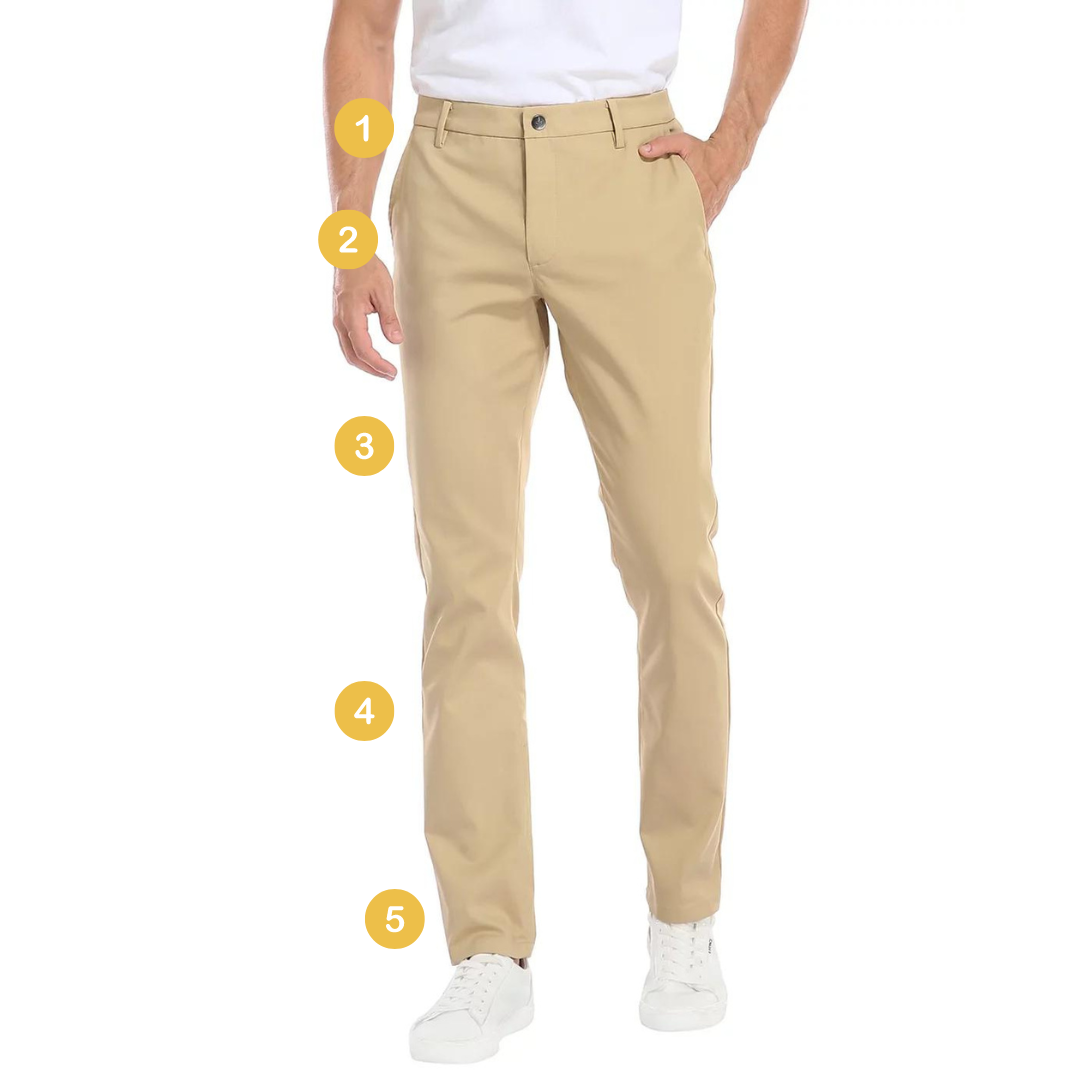
- They should fit your waist without the need for a belt.
Slightly too tight on the waist is okay as they will stretch out slightly after a few hours.
- The seat of your chinos should _lightly_ hug your butt without being too tight or too baggy.
- Should only be able to pinch 1-1.5 inches (2.5-3.8cm) on either side of your thigh.
- Should only be able to pinch 1-2 inches (2.5-5cm) on either side of your calf AND ankle.
- Slight or no break on the cuff.
Chinos should not have much bunching of fabric around the ankle. It will throw off your proportions.
Outfit Ideas
Casual {#casual}
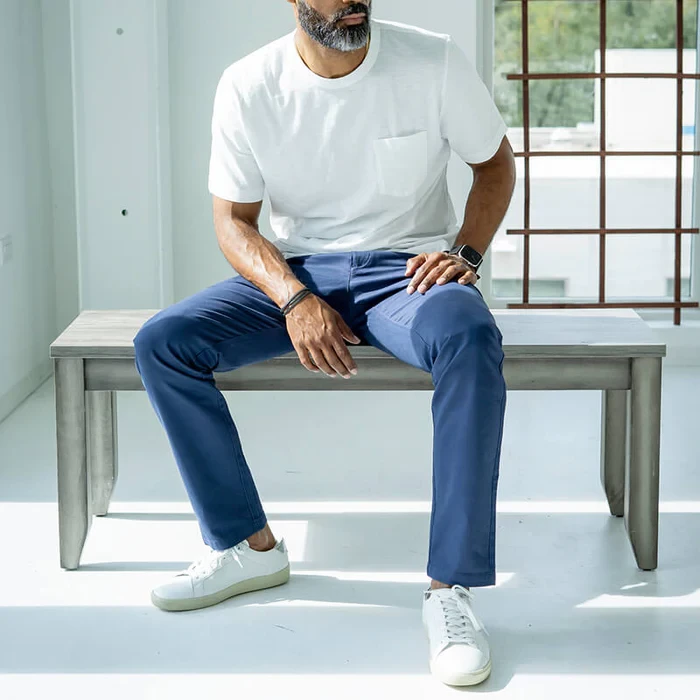
When it comes to layering, the work shirt could be easily swapped out for a denim trucker or navy bomber jacket. Also, you could always go for a pair of boots or loafers if you wanted something dressier than the sneakers shown here.
Elevated Casual {#elevated_casual}
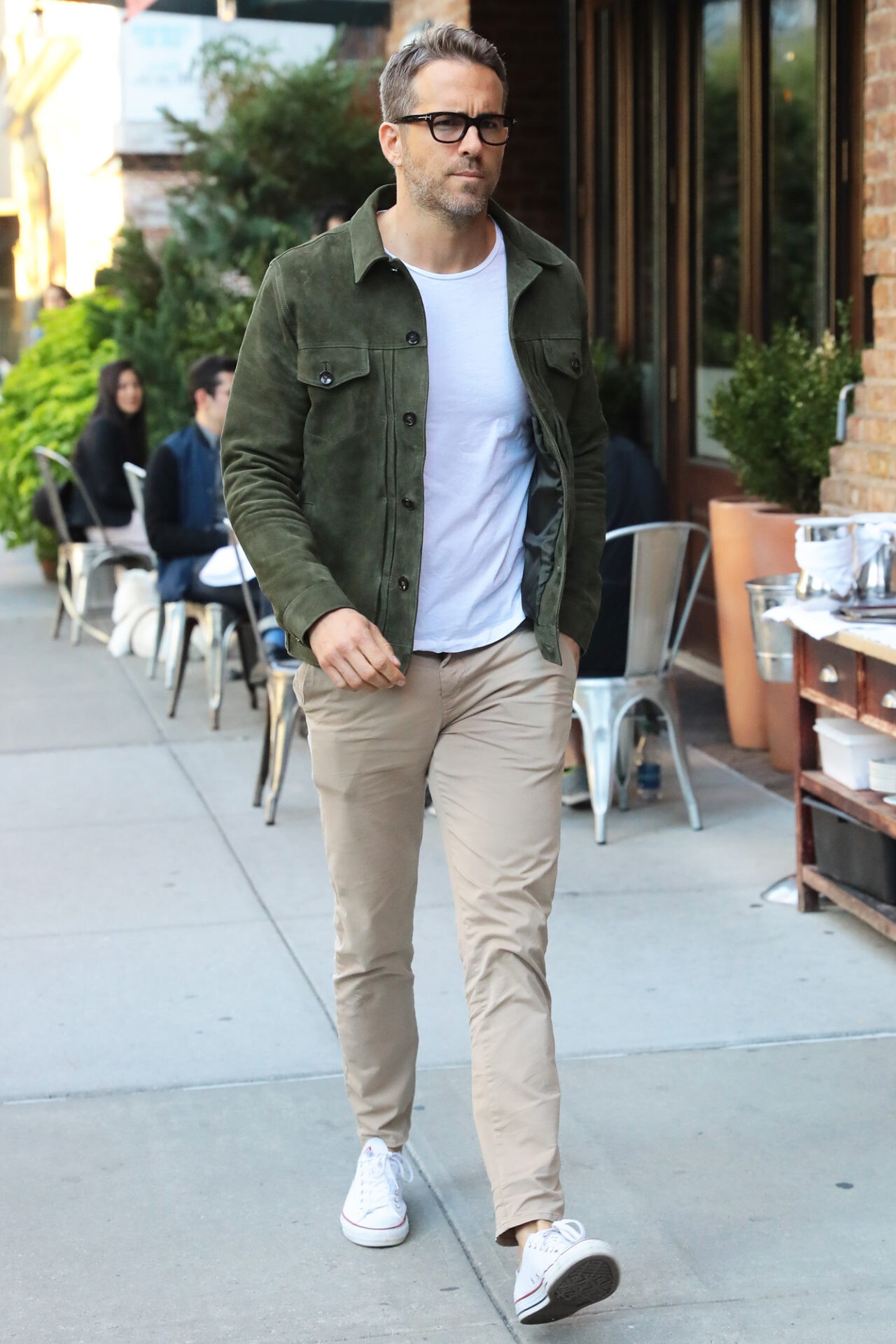
Nothing elevates a casual outfit quite like a suede trucker jacket. This combo allows you to easily mix and match your choice of chinos and t-shirt and if you don't have a suede bomber, a blue denim version would also work really well here.
Business Casual {#business_casual}
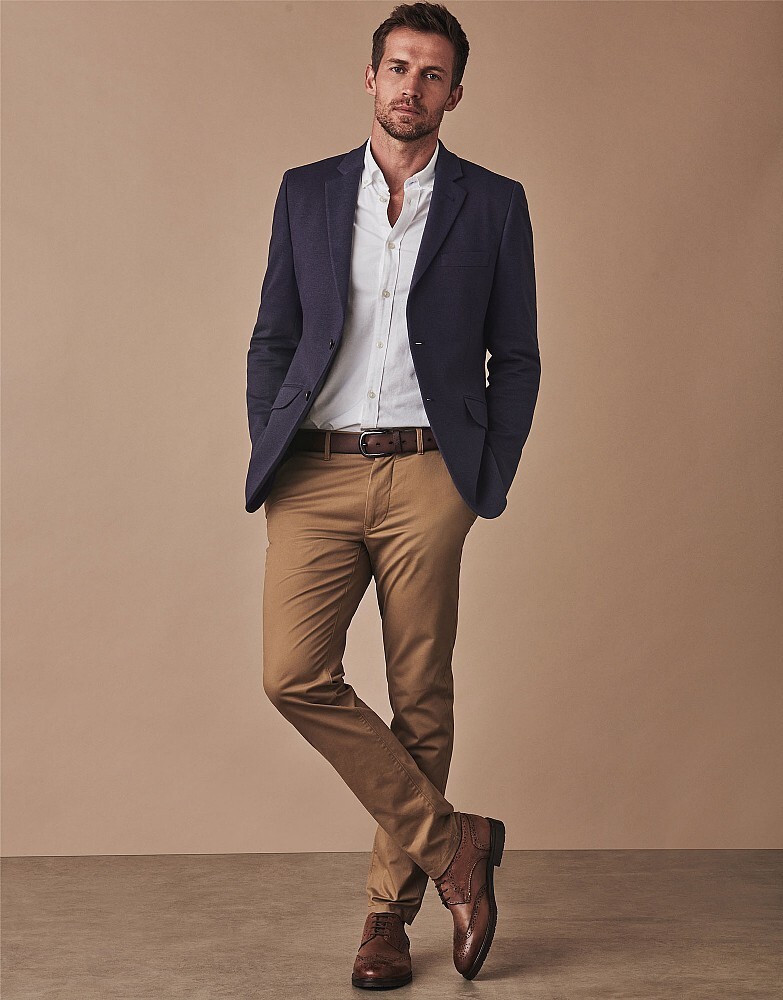
This outfit formula never fails to impress. If you get too hot, feel free to remove the blazer and if you want to dress it down, you could always swap out the dress shoes for a pair of shiny white low-top sneakers.
Related Comparisons
- Chinos vs Khakis — What's the Difference?
- Wool Trousers vs Chinos — Which Pants Do You Need?
- Jeans vs Chinos — Key Differences
Khaki Chinos: How to Wear
Khaki chinos (the tan/stone-colored classic) are the most versatile pant in menswear. Five outfit formulas that always work:
1. The Casual Default
Khaki chinos + white crew-neck t-shirt + white leather sneakers. The cleanest casual look possible. Add a navy bomber jacket for cooler weather.
2. The Smart Casual
Khaki chinos + light blue Oxford shirt (untucked or French-tuck) + brown leather loafers + brown leather belt. Works for dinners, dates, and daytime events.
3. The Office Look
Khaki chinos + white tucked dress shirt + brown leather Derby shoes + brown belt + navy blazer. The classic business casual khaki outfit.
4. The Weekend Layered Look
Khaki chinos + olive henley + brown suede chukka boots + brown leather watch strap. Great for cool fall weekends.
5. The Summer Polish
Khaki chinos + white linen shirt (rolled sleeves) + brown leather loafers (no socks) + sunglasses. Warm-weather elevated casual.
Color pairing rule: Khaki/tan chinos go with almost everything except orange, yellow, and competing earth tones. White, navy, light blue, olive, and grey are the safest top colors.Chinos for the Office
Chinos are the default business casual pant in most modern offices. Here's how to get it right.
Best office colors: Navy, charcoal, and stone. These three cover every business casual situation. Olive works in creative environments. Avoid bright or pastel colors. Pair with structured tops. A tucked dress shirt or Oxford shirt elevates chinos to office-appropriate. Add a blazer for meetings and presentations. See our business casual guide for complete office formulas. Shoe selection. Leather loafers, Oxford shoes, or polished Derby shoes. Skip the sneakers for the office — even clean white ones read too casual in most professional settings. Check our dress shoe guide. Hem length. A clean break (no stacking, no excess fabric) is essential for a polished office look. Get them hemmed if needed — most tailors charge under $15. Belt rule. Always wear a leather belt with tucked shirts. Match the belt color to your shoes — brown belt with brown shoes, black with black. What separates office chinos from weekend chinos: Construction quality (thicker fabric, structured waistband), color (darker and more neutral), and hem (tailored, not cuffed). You can wear the same pair for both — just change the top half.Chinos vs Dress Pants
Both are trouser options for professional settings, but they serve different purposes.
Fabric: Chinos are cotton twill — smooth, durable, and slightly casual. Dress pants (trousers) are typically wool, wool-blend, or tropical weight — more refined and drapier. Formality: Dress pants are more formal. They pair with suits, dress shirts, and formal shoes. Chinos are business casual — they pair with blazers, polos, and loafers. Crease: Dress pants typically have a pressed center crease. Chinos are flat-front with no crease. Adding a crease to chinos doesn't make them dress pants — it just looks wrong. When to choose chinos: Business casual offices, smart casual events, date nights, travel. When comfort and versatility matter. When to choose dress pants: Formal offices, client meetings, presentations, weddings, and any setting where a suit isn't required but professionalism is expected. See our wool trousers guide for a deep dive. The overlap zone: In many modern offices, dark navy or charcoal chinos serve the same role as dress pants. If your office is business casual, well-made chinos in these colors are often indistinguishable from wool trousers at a glance.